



Gum health · Scientific guide · 9 min read
Receding gums: how to clean deeply without making gum recession worse
Do your teeth look longer than they used to? Does cold make you wince right at the gumline? Are small dark triangles appearing between your teeth? These are the typical signs of gingival recession, more commonly known as "receding gums".
When they notice it, most people do one of two things: they brush harder to "clean properly", or they avoid the area because it is sensitive. Both reactions make the problem worse. This guide explains why, from a mechanical point of view, and what to do instead.
|
The essentials in 1 minute
|
Take the test: are your gums receding?
|
☐ One or more teeth look longer than they did a few years ago ☐ Cold or heat causes sensitivity right at the gumline ☐ Your fingernail catches on a small step or notch near the gum ☐ Dark spaces are appearing between your teeth ☐ Your gums sometimes bleed when you brush ☐ The bristles of your toothbrush flatten and splay in less than three months |
Two or more boxes ticked? Your gums are probably affected by one of the two drivers of recession described below. Talk to your dentist, and adapt your brushing from tonight. The last box is a valuable clue: bristles that flatten quickly almost always point to excessive pressure.
What really happens when a gum recedes
The gum is not just tissue resting on the tooth. It is attached to the root by fibres and sits on the bone that surrounds the tooth. When it "recedes", its edge moves towards the root and exposes part of it. But the root is not protected by enamel: it is covered by a softer tissue, cementum, and then by dentine, which is crossed by tiny channels connected to the nerve. This explains the sensitivity to cold, and why the tooth neck is so vulnerable to friction.
It is very common. According to a review published in the Journal of the American Dental Association, half of adults aged 18 to 64 and 88% of people over 65 have at least one site of gingival recession (Kassab and Cohen, 2003).
The two drivers of gum recession
1. The biological driver: plaque and inflammation
Dental plaque is a biofilm: a colony of bacteria organised within a sticky matrix that constantly rebuilds itself. When it sits at the gumline, the immune system reacts. This is gingivitis: redness, swelling, bleeding. If the inflammation persists, it eventually destroys the attachment fibres and the bone. This is periodontitis. The gum then follows the bone as it shrinks, and the tooth loses its support.
2. The mechanical driver: too much force, not enough precision
Brushing itself can wear down the gum and the neck of the tooth. The risk factors most often described are hard or medium bristles, a horizontal back-and-forth movement, excessive pressure and an overly abrasive toothpaste. All specialists agree on one point: when the gum is already fragile, scrubbing hard brings no benefit at all.
On top of that come factors you cannot control: naturally thin gums, the position of a tooth in the arch, smoking or past orthodontic treatment.
The brushing paradox: why the force of your hand is the wrong tool
To remove a biofilm, you need to apply a shear force, in other words a force that slides parallel to the surface and tears away the sticky matrix. With a manual toothbrush, this force can only come from one source: your hand. The more you want to clean, the harder you press. And the harder you press, the more the bristles rub the gum and wear down the tooth neck.
That is the paradox. A receding gum needs to be cleaned better than before, at the gumline and below it, while pressing less. A manual toothbrush cannot solve this equation, and a rotating toothbrush only partly does. A sonic toothbrush can: it changes the source of the energy, follows the right movement and its bristles absorb pressure.
| Comparison | Manual toothbrush | Rotating toothbrush | SG8+ sonic toothbrush |
| Energy source | Your hand: pressure and movement | The motor spins a small round head | The motor: up to 42,000 movements per minute |
| Movement | Back and forth, often horizontal | Circular rotation that does not follow the recommended pink-to-white movement (impossible at the gum/enamel junction) | Vibration that supports the recommended pink-to-white movement, from the gum towards the tooth |
| Bristles | Soft to medium, often too stiff for a fragile gum | Usually stiffer, to withstand the rotation | Konex HD, 0.02 mm, ultra-soft at the tip |
| Pressure on the gum | All the force of the hand is transmitted to the gum | When you press, the rotation and stiff bristles rub the edge of the gum and risk pushing it back | The bristles absorb excess pressure: they flex instead of pushing on the gum |
| Area cleaned | Only where the bristles touch | Only where the bristles touch | The bristles, plus 2 to 3 mm beyond them thanks to fluid movement |
| Heads | A single shape | Usually one round head | 4 differently shaped heads: between the teeth, at the gumline and in the gingival sulcus |
| Consistency | Depends on tiredness and attention | Varies by model | Quadrant timer over 2 minutes |
The mechanics of friction-free cleaning
The hydrodynamic effect: cleaning where the bristles do not touch
At around 700 movements per second, the head of the SG8+ does more than scrub. It sets in motion the mixture of saliva, water and toothpaste around it. This liquid forms micro-currents and micro-bubbles that shear the biofilm up to 2 to 3 mm beyond the tips of the bristles: at the entrance to the spaces between the teeth and in the groove that lines the gum. Think of the difference between scraping a window with a sponge and rinsing it with a hose: part of the work is done without contact, and therefore without wear.
The physics of bristles: why 0.02 mm changes everything
The stiffness of a bristle depends mainly on its diameter, and not in a proportional way. In mechanics, for the same length and material, the bending resistance of a cylindrical filament varies with the fourth power of its diameter. In practice, a bristle twice as thin is sixteen times more flexible, and a bristle five times thinner is around six hundred times more flexible.
The Konex HD bristles on EDELWHITE heads measure 0.02 mm at the tip, compared with around 0.1 mm for the so-called "soft" bristles of many toothbrushes. Their tapered shape makes them firm at the base, to transmit the sonic energy, and extremely flexible at the tip, to follow the contour of the gum and slip into the gingival sulcus without harming it.
|
Deep cleaning without scrubbing is possible The SG8+ Health Suite combines the hydrodynamic effect, 0.02 mm bristles that absorb pressure and four specialised heads. Discover the SG8+ Health Suite |
Why the SG8+ Health Suite is designed for receding gums
| What your gums need | What the SG8+ Health Suite does |
| Remove plaque at the gumline without pressing | Hydrodynamic effect at 42,000 movements per minute, active 2 to 3 mm beyond the bristles |
| Contact that wears down neither the gum nor the tooth neck | Konex HD bristles of 0.02 mm, ultra-soft at the tip, that absorb excess pressure |
| Care for exposed tooth necks one by one | Single-tuft Target head that follows the contour of each tooth |
| Avoid overbrushing one area and forgetting another | Quadrant timer over 2 minutes |
| An intensity suited to sensitive areas | Sensitive mode, plus Active and Yoga modes (helpful for massaging the gums and improving blood circulation) |
| Clean between the teeth, at the gumline and in the gingival sulcus | Four differently shaped heads to reach every area |
| Keep up the routine over time | Up to 1 month of battery life |
A 4-step routine to protect receding gums
| 1 | Place, don't scrub. Hold the toothbrush like a pen, with your fingertips. Place the Dual Clean head at 45° towards the gum, in Sensitive mode, and glide it slowly using the pink-to-white movement, that is from the gum towards the tooth, two to three seconds per tooth. The timer tells you when to move to the next quadrant. |
| 2 | Take care of the tooth necks. Use the Target head for 30 seconds on exposed tooth necks and along the gumline, following the contour of each tooth. |
| 3 | Clean between your teeth. Use interdental brushes of the right size, or a water flosser if your gums are sensitive or if your dentist has measured pockets. |
| 4 | Choose a low-abrasion toothpaste. If your tooth necks are sensitive, a desensitising gel such as STOP Sensitive with BioMin technology can bring relief. See our toothpastes. |
Replace your toothbrush head every three months, or sooner if the bristles splay. If they flatten quickly, it is a sign that you are still pressing too hard.
What a toothbrush cannot do, and when to see your dentist
Let's be clear: no toothbrush can make a gum grow back. Established recession can only be corrected with surgery, through a gum graft, and only in some cases. The role of good brushing is to remove the two drivers of recession in order to stabilise the situation, and to protect the result if you have had surgery.
See your dentist or a periodontist if a tooth feels loose, if your gums have been bleeding for more than two weeks, if pus appears, if the recession visibly progresses within a few months, or if you have not had a periodontal check-up recently.
|
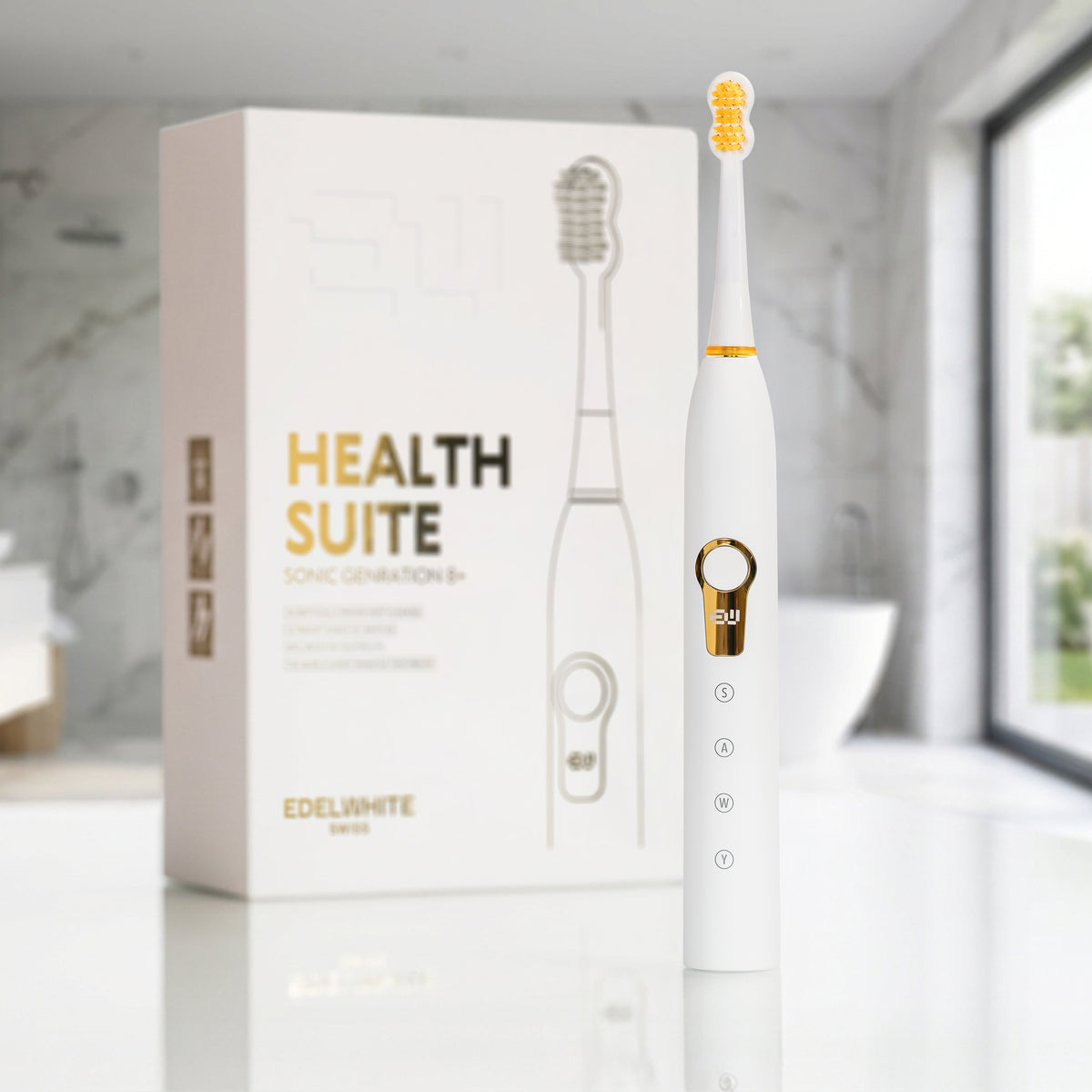
Swiss dental engineering EDELWHITE SG8+ Health Suite 4 heads · 4 modes including Sensitive · 0.02 mm Konex HD bristles · up to 1 month of battery life |
Frequently asked questions
Can receding gums grow back?
No, not on their own. Once the tissue is lost, only a gum graft can cover part of the root, depending on the case. However, appropriate oral hygiene can stop the recession from progressing.
Can an electric toothbrush make gum recession worse?
A sonic toothbrush used correctly will not. You place the head, guide it from pink to white without pressing, and the Konex HD bristles absorb excess pressure. The risk comes mainly from bristles that are too stiff and from excessive pressure.
Sonic or oscillating-rotating toothbrush for receding gums?
For receding gums, sonic technology is the better fit. Part of the cleaning is done by fluid movement, without contact, and the vibration supports the pink-to-white movement. Rotation does not follow this movement and generally uses stiffer bristles, which rub the edge of the gum more.
Which SG8+ mode should I use if my gums are sensitive?
Start with Sensitive mode for the first two weeks. After that, you can switch to Active mode on the tooth surfaces and keep Sensitive mode along the gumline, using the Target head on exposed tooth necks.
Why are my teeth sensitive to cold when my gums recede?
The exposed root is not protected by enamel. Its dentine contains tiny channels connected to the nerve, which transmit cold and heat. A low-abrasion toothpaste, a desensitising gel and pressure-free brushing help limit this sensitivity.
How often should I change my toothbrush head?
Every three months on average, or as soon as the bristles splay. Worn bristles clean less effectively and rub the gum more.