



Periodontitis · Scientific guide · 9 min read
Periodontal pockets: how to clean where your toothbrush never reaches
Your dentist took out a small graduated probe, read out some numbers ("3, 4, 5...") and talked about "pockets". Since then, you have been brushing diligently. Yet your gums still bleed, your breath is not always fresh, and your next check-up worries you.
It is not a lack of willpower. It is a problem of geometry: a periodontal pocket is an area that neither your toothbrush, nor dental floss, nor mouthwash can properly reach. Here is why, with the figures to prove it, and how pulsating water changes the game.
|
The essentials in 1 minute
|
What exactly is a periodontal pocket?
Around each tooth, the gum forms a small groove, like the collar of a jumper around your neck. In a healthy person, it measures 1 to 3 mm. When periodontitis sets in, inflammation gradually destroys the fibres that attach the gum to the root, and then the bone: the groove deepens and becomes a pocket. Your dentist measures it with a graduated probe. From 4 mm, it is called a pocket; from 6 mm, a deep pocket.
Periodontitis is far from rare. According to the World Health Organization, its severe forms affect around one adult in five worldwide, which is more than a billion people.
Why a pocket gets worse on its own: the vicious circle
A pocket is a closed, moist, warm environment with little oxygen. It is the ideal home for anaerobic bacteria, the ones that live without oxygen and are the most aggressive towards the tissues that support the tooth. They release substances that keep the inflammation going, as well as volatile sulphur compounds, which cause unpleasant breath.
The deeper the pocket, the harder it is to clean. The harder it is to clean, the more these bacteria settle in. And the more they settle in, the deeper the pocket becomes. Treatment at the dentist (scaling and root planing) resets the clock, but the bacteria under the gum tend to grow back within a few weeks to a few months. That is why your daily hygiene, between appointments, decides what happens next.
|
Signs that should make you think of pockets ☐ Gums that bleed when you brush, even gently ☐ Gums that are red, swollen or pulling away from the tooth ☐ Bad breath or an unpleasant taste that keeps coming back despite brushing ☐ Food that always gets stuck in the same places ☐ Teeth that are loose, drifting apart or changing position |
What each tool really reaches below the gum
Researchers have measured how far each hygiene method goes below the edge of the gum, often by using a dye and then examining extracted teeth. The results explain why so many diligent patients still have active pockets.
| Tool | Depth reached below the gum | For a 5 mm pocket |
| Mouthwash | About 21% of the depth | The liquid stays almost at the surface |
| Toothbrush | About 1 mm for the bristles | The bottom of the pocket is never reached |
| Dental floss and interdental brushes | About 2 to 3 mm | Effective between the teeth, rarely at the bottom |
| Water flosser, standard tip | 44 to 71% of the depth | About half of the pocket is rinsed |
| Water flosser, subgingival tip | Up to 90% of a 6 mm pocket, 64% beyond 7 mm | Almost the entire pocket is reached |
Sources of the measurements: Pitcher et al., 1980 (mouthwash); Eakle et al., 1986 (standard tip); Braun and Ciancio, 1992 (subgingival tip). The values for the toothbrush and dental floss are orders of magnitude commonly accepted in periodontology.
The mechanics of pulsating water: why the pulse matters more than the pressure
A water flosser does not send a simple continuous stream of water. It sends water in rapid pulses. Each pulse creates two zones: an impact zone, where the water hits the gum and the tooth, and a flushing zone, where it rushes under the edge of the gum before flowing back out, carrying debris with it.
It is the alternation that does the work. The pressure phase pushes the water towards the bottom of the pocket; the release phase lets it flow back out, loaded with loose bacteria and debris. Picture a wave running up the beach and then pulling back, taking the sand with it: a continuous stream, on the other hand, would tend to bounce off the surface. These rapid variations also create shear forces that break up the least adherent part of the biofilm.
The tip does the rest. A standard tip, held at the edge of the gum, sends water into the pocket from above. A subgingival tip, placed gently just below the edge of the gum, brings the water outlet as close as possible to the bottom. Hence the difference in the measurements: about half of the pocket in the first case, up to 90% in the second.
What the studies say
The water flosser has been studied since it first appeared in the 1960s. Clinical trials report a significant reduction in bleeding, gingivitis and plaque and, in some patients, a decrease in pocket depth and in the bacteria associated with periodontitis. Benefits have also been observed in patients with diabetes and in those on periodontal maintenance programmes (Jahn, 2010).
One important point: the water flosser does not remove tartar or old biofilm firmly attached to the root. That is the dentist's job. The role of the water flosser is to break up the plaque that re-forms every day and to rinse the pocket before the bacteria settle back in.
|
Reach the bottom of your pockets, every day The Power Spa comes with a subgingival tip and can be used in the shower, with no splashing. Discover the Power Spa |
Why the Power Spa is designed for periodontal pockets
| What a pocket needs | What the Power Spa does |
| Cleaning that reaches the bottom of the pocket | Dedicated subgingival tip, in addition to the standard jet tip |
| Break up plaque without irritating inflamed gums | 4 modes, including Pulse mode |
| Focus on each space between the teeth | Spot Clean mode: water only comes out while you hold the button |
| Clean around bridges and implants | Brush tip with ultra-soft Konex HD bristles that brushes and rinses at the same time |
| Reduce the bacteria behind bad breath | Tongue cleaner included |
| Keep the habit every day | IPX7 waterproof, can be used in the shower; cordless and USB rechargeable |
| A clean device, with no stagnant water | Fully opening tank, easy to rinse and dry |
| Use a solution prescribed by your dentist | Materials compatible with chlorhexidine and alcohol-free mouthwashes |
The best water flosser is the one you actually use. This is often where countertop devices fail: splashing, power cords, bulky tanks. By taking it into the shower, the Power Spa turns a chore into a 90-second habit, and it is consistency that protects a pocket.
The winning duo: sonic toothbrush and water flosser
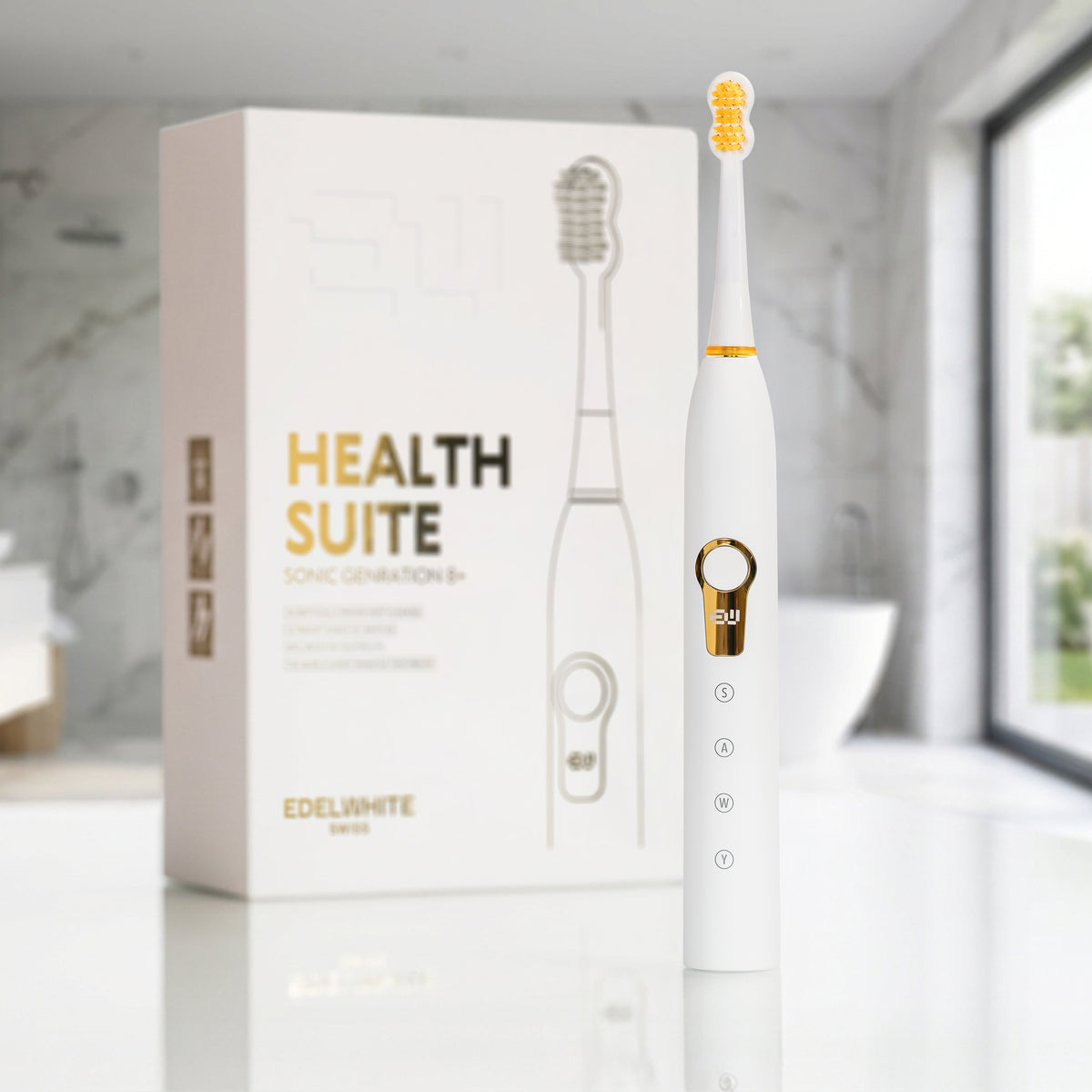
A toothbrush and a water flosser do not do the same job. The SG8+ Health Suite sonic toothbrush removes plaque from the tooth surfaces and at the gumline, with a hydrodynamic effect that works 2 to 3 mm beyond its bristles. The Power Spa takes over where the toothbrush stops: between the teeth and deep inside the pockets. Together, they cover the whole height of the problem, from the crown of the tooth down to the bottom of the pocket.
|
SG8+ Health Suite · €149 Tooth surfaces, gum edge, entrance to the sulcus. 0.02 mm Konex HD bristles, 4 heads, Sensitive mode. |
Power Spa · €89 Spaces between the teeth and inside the pockets. Subgingival tip, 4 modes, usable in the shower. |
The 5-step Power Spa routine, about 90 seconds
| 1 | Fill the tank with lukewarm water. If your dentist has prescribed a solution, this is the time to add it. Otherwise, water is enough, possibly with an alcohol-free mouthwash. |
| 2 | Brush your teeth first. The water flosser then flushes out what the toothbrush has loosened. |
| 3 | Follow the gumline with the jet tip. In Sensitive mode for the first week, with your lips slightly open, aim the jet at a right angle to the gumline. Pause for 2 to 3 seconds in each space between the teeth, first on the outside, then on the inside. |
| 4 | Use the subgingival tip on your pockets. On the areas your dentist has pointed out, place it gently at the edge of the gum, without forcing it, and let the water flow in for a few seconds per site. |
| 5 | Finish with your tongue. Run the tongue cleaner from back to front, two or three times. |
Do your gums bleed during the first few days? This is common when they are inflamed. The bleeding usually decreases after one to two weeks of daily use. If it persists, talk to your dentist.
What a water flosser does not replace
The Power Spa is a daily hygiene tool, not a treatment. It does not replace a periodontal check-up, root planing or maintenance sessions with your dentist or periodontist, usually every 3 to 6 months when you have pockets. See your dentist promptly if a tooth feels loose, if pus appears, if a gum suddenly swells or if bleeding lasts more than two weeks.
|
Swiss dental engineering EDELWHITE Flosserpik Power Spa Subgingival tip · 4 modes · waterproof · cordless |
Frequently asked questions
Can a water flosser replace dental floss?
For people with pockets, bridges, implants or braces, a water flosser is often easier to use and reaches areas that floss cannot follow. If the spaces between your teeth are wide, interdental brushes remain a good complement. Your dentist can tell you what suits your mouth.
Can the water jet push bacteria deeper into the pocket?
The pulsating water flows in and back out of the pocket with each pulse, carrying debris with it. Water flossers have been used for more than sixty years, and clinical studies have not shown this risk in daily users. Start in Sensitive mode and never force the tip under the gum.
Can I put mouthwash in the Power Spa?
The Power Spa's materials are compatible with chlorhexidine and alcohol-free mouthwashes. If your mouthwash contains fluoride, like our Fresh & Protect, it can be used daily, in line with its instructions for use.
Does a water flosser help with bad breath caused by pockets?
Yes, in part. The sulphur compounds behind bad breath are produced by anaerobic bacteria in the pockets and on the back of the tongue. Rinsing the pockets every day and cleaning your tongue with the included accessory tackles both sources. If bad breath persists, see your dentist.
Is the Power Spa suitable for implants and bridges?
Yes. Sensitive mode with the jet tip cleans around the neck of implants and under bridge pontics, and the Konex HD brush tip helps remove plaque in hard-to-reach areas.
How long does a session last, and how often?
Allow 60 to 90 seconds, once a day, ideally in the evening or in the shower. Consistency matters more than duration.