


Periodontitis & Gingivitis · Scientific guide
Which electric toothbrush works best against periodontitis and gingivitis?
Gums that bleed when you brush, persistent inflammation, sensitivity that keeps getting worse, gums that gradually recede: these signs are often played down, yet they are the visible expression of a pathological continuum that runs from reversible gingivitis to irreversible, destructive periodontitis. Epidemiological surveys across Europe consistently show that more than 50% of adults have some form of gingivitis and that roughly 10 to 15% live with severe periodontitis.
Against that background, choosing an electric toothbrush cannot come down to marketing or whitening claims. It becomes a clinical decision. Far too many consumer devices are engineered for aesthetics, for a sensation of freshness or for whitening, with no regard for the biomechanical constraints of inflamed periodontal tissue.
This guide sets out the scientific criteria that separate a toothbrush suited to gum disease from a simple comfort product. It compares the options available on the market and assesses them against the requirements of clinical periodontology.
Understanding the disease in order to choose the right tool
Gingivitis and periodontitis: two distinct clinical entities
Gingivitis is a reversible inflammation of the gums, confined to the soft tissue, with no attachment loss and no bone destruction. It presents as redness, gingival oedema, bleeding on probing (BOP above 10%) and heightened sensitivity. Effective, consistent brushing combined with interdental cleaning allows full resolution over time.
Periodontitis is a chronic inflammatory disease triggered by gram-negative anaerobic bacteria in the subgingival biofilm (Porphyromonas gingivalis, Tannerella forsythia, Treponema denticola, Socransky's red complex). It causes progressive, irreversible destruction of the supporting connective tissue and the alveolar bone, generating periodontal pockets (depth above 4 mm), measurable clinical attachment loss (CAL) and potentially tooth mobility. It is classified into stages I to IV and grades A, B and C under the 2017 international classification (Tonetti et al.).
Unlike gingivitis, periodontitis does not resolve on its own. It requires specialist treatment (root planing, supportive periodontal therapy) and impeccable mechanical hygiene at home to control residual inflammation.
Dental biofilm and periodontitis: how bacterial plaque destroys the periodontium
Dental biofilm (dental plaque) is a structured community of micro-organisms embedded in an extracellular polymer matrix, adhering to tooth and gum surfaces. Its composition shifts over time: young plaque (1 to 3 days) is dominated by harmless gram-positive cocci, while mature plaque (7 to 14 days) gives way to pathogenic anaerobic gram-negative rods.
The virulence of periodontopathogenic species lies in their ability to modulate the host immune response: they produce proteases (gingipains) that degrade immunoglobulins and sustain chronic low-grade inflammation. It is not the infection itself that destroys bone, but the host's dysregulated inflammatory response to that pathogenic biofilm. The aim of brushing is therefore to keep the plaque index (PI, Silness and Löe) below 20%, the threshold associated with periodontal stability.
The oral microbiome: towards an ecosystem approach
The oral microbiome contains more than 700 bacterial species catalogued in the Human Oral Microbiome Database (HOMD). In a healthy individual, a dynamic balance exists between benign commensal species and potentially pathogenic ones. Excessively aggressive brushing, or brushing with powerful abrasives, can disturb the protective commensal flora and create an ecosystem that favours dysbiosis. Regular but atraumatic brushing, by contrast, reduces the pathogenic load without disrupting the oral microbial ecosystem as a whole.
Sonic or oscillating-rotating: which is better suited to active inflammation?
The two main electric brushing technologies are oscillating-rotating (roughly 8,000 to 9,000 rotations per minute) and sonic (30,000 to 50,000 sweeping movements per minute). In the context of active gum disease, they are not equivalent.
Oscillating-rotating heads apply alternating lateral forces to the marginal gingiva on every oscillation cycle. On inflamed tissue, which is oedematous and whose sulcular epithelium is ulcerated, this repeated movement can sustain mechanical irritation. A study by Tritten and Armitage (1996) documented a significantly greater reduction in proximal subgingival plaque with a sonic brush than with an oscillating-rotating brush after six weeks of use.
The hydrodynamic effect of sonic brushes: a documented advantage
Sonic brushes work through high-frequency vibration. The optimal range validated by clinical studies lies between 30,000 and 50,000 sweeping movements per minute. Below 30,000 movements, the hydrodynamic effect within the sulcus remains limited. Above 50,000 to 60,000 movements per minute, the mechanical power transmitted to the tissue can become excessive for inflamed gums.
These vibrations generate two complementary mechanisms. On one side, direct mechanical action removes biofilm from the surfaces in contact. On the other, hydrodynamic action creates micro-flows of fluid within the gingival sulcus, capable of disturbing and destabilising biofilm in zones 0.5 to 5 mm beyond direct bristle contact (Haffajee et al., 1995; Sharma et al., 1998). This phenomenon is particularly valuable for reaching proximal subgingival biofilm without traumatic mechanical penetration.
A meta-analysis published in the Journal of Clinical Periodontology (Deacon et al., 2010) showed that sonic brushes significantly reduce the plaque index (−8.5% versus a manual brush) and gingival bleeding (−5.3%) after a few weeks of use in periodontal patients in the maintenance phase.
The clinical criteria for a toothbrush suited to gum disease
Fineness and softness of the bristles
Bristles need an ultra-fine diameter so that they can penetrate gently into the gingival sulcus (0.5 to 1 mm) without traumatising the junctional epithelium. The suppleness of the filaments (nylon 6.12 or polybutylene terephthalate) must allow elastic deformation under pressure, so that the forces transmitted to the gum are cushioned.
Brushing pressure: the invisible risk factor
One of the least documented risks in consumer communication is that of repeated micro-trauma. Excessive brushing pressure (above 300 to 400 g), applied daily to inflamed and weakened gums, can worsen gingival inflammation through mechanical trauma, accelerate gingival recession, expose the cemento-enamel junction and encourage dentine hypersensitivity.
A study by Heasman et al. (2017), published in the British Dental Journal, documented that 74% of gingival recessions are associated with traumatic brushing or an unsuitable technique. The optimal pressure recommended by clinical consensus is 150 to 200 g, the equivalent of a finger resting gently on a surface. Beyond 250 g, you enter the traumatic zone for inflamed tissue.
This is why a pressure-control mechanism is indispensable in a periodontal context. It can take two forms: an alert sensor (a light or sound signal telling the user that pressure is excessive, which reduces average pressure by 35 to 55% after four weeks according to Heasman et al., 2017), or an active mechanical absorber built into specialised bristles, which directly reduces the force transmitted to the tissue without requiring any reaction from the user.
Frequency within the optimal range
For sonic electric toothbrushes, a frequency between 30,000 and 50,000 movements per minute is the range in which the sulcular hydrodynamic effect is at its maximum without generating excessive vibratory energy for inflamed tissue. Brushes positioned below 30,000 movements per minute do not fully exploit the sulcular effect. Those exceeding 60,000 movements per minute can generate power that is unsuitable for very sensitive gums.
Head design: why a single head is not enough with periodontitis
Imagine having to clean your entire house with one broom, in one size, for everything: the hallway, the corners of every room, under the furniture, the recesses behind the radiators. Some areas would remain permanently out of reach, no matter how good the broom. The oral cavity works on exactly that principle: each anatomical zone (buccal surfaces, lingual and palatal surfaces, posterior areas, the marginal gingiva, interdental spaces, the gingival sulcus) presents different access constraints. A single head, however well engineered, cannot meet all of those geometric demands.
With periodontitis, this reality becomes clinically critical. Periodontal pockets, areas of recession and localised bone loss multiply the number of micro-territories that a uniform approach cannot reach. Having several heads suited to each situation is therefore essential: a small rounded head for precise positioning at the gum-tooth junction in posterior and lingual areas; a superfine head to penetrate gently into the inflamed gingival sulcus without traumatising the junctional epithelium; a standard head for accessible smooth surfaces.
This principle of total coverage does not stop at the brush head. Even the Edelwhite sonic brush cannot reach every interproximal contact surface, and those surfaces account for close to 40% of the tooth surface exposed to biofilm. Dental floss or interdental brushes remain indispensable for those areas, and a water flosser completes the routine by irrigating the base of the sulcus and the spaces created by periodontal destruction. Where periodontitis is established, maintaining every oral surface is not optional: it is the precondition for long-term periodontal stability.
The best electric toothbrushes for periodontitis: clinical analysis
The criteria used for this analysis are: sonic frequency (optimal range 30,000 to 50,000 movements/min), pressure protection, bristle fineness, suitability for sensitive gums and the availability of heads dedicated to gum health.
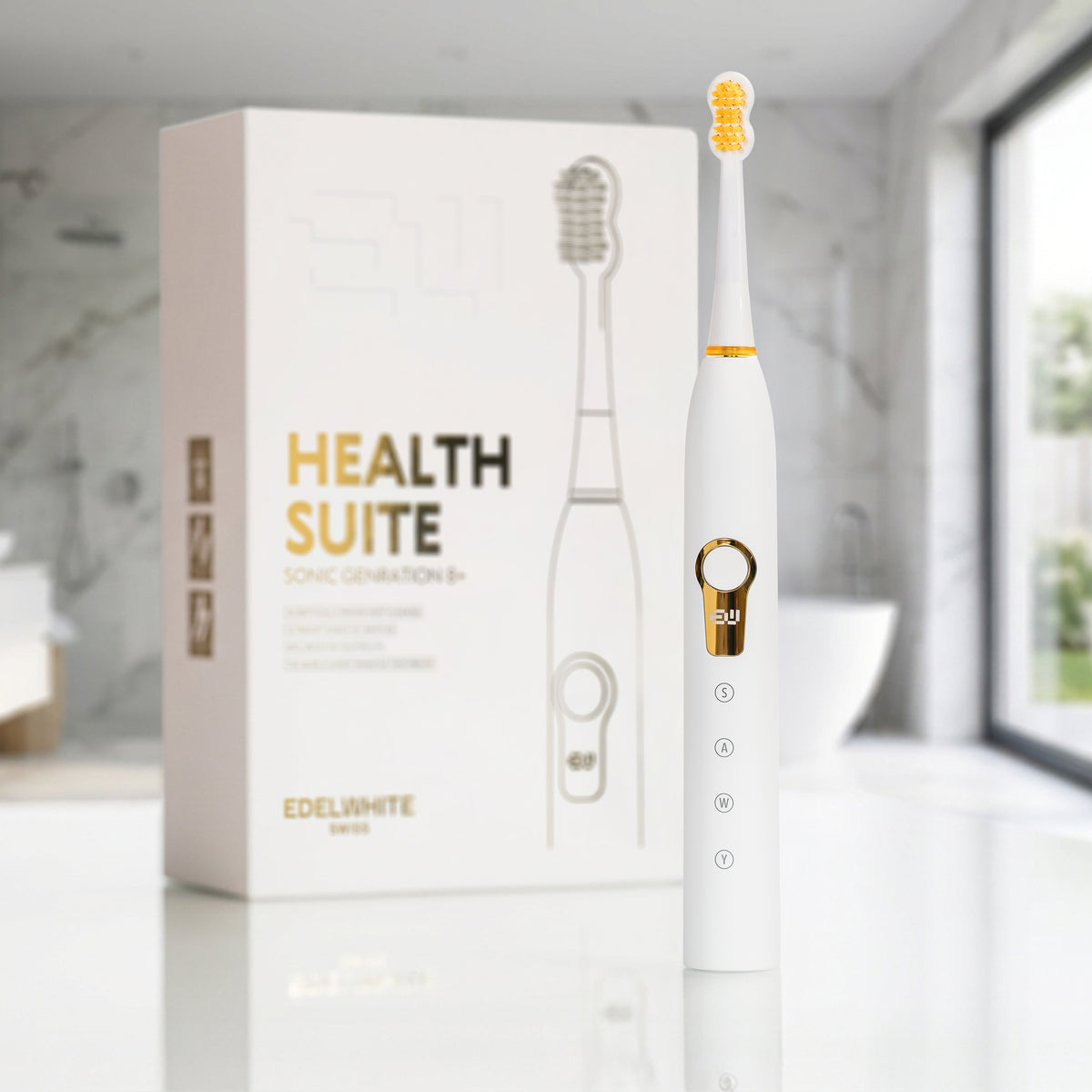
1. Edelwhite 8 Health Suite: the clinical benchmark for periodontitis
Official link: edelwhite.com | Periodontal heads
The 8 Health Suite is the only brush in this comparison designed from the outset around the demands of periodontal maintenance. Its sonic frequency of 45,000 movements per minute sits at the heart of the clinically validated optimal range (30,000 to 50,000 mvt/min) for the sulcular hydrodynamic effect. Below 30,000, the micro-flows within the sulcus remain insufficient to destabilise subgingival biofilm; above 60,000, the vibratory energy can become counterproductive on gums in a phase of active inflammation.
Konex HD technology is the major clinical differentiator. This is not an alert sensor that tells the user pressure is excessive, as on most brushes on the market. It is a patented active mechanical absorption system, physically built into the bristles through the difference in thickness between the base of the bristle and its tip, which directly and instantly reduces the force transmitted to the gum without requiring any behavioural reaction from the user. An alert sensor only protects the tissue if the user changes their technique in real time, which presupposes a learning phase of several weeks. Konex HD bristles protect from the very first use, including in people who have been brushing hard for years.
The third pillar is the range of heads, all fitted with bristles whose tips reach 0.02 mm in diameter, the finest on the world market. The Dual Clean head covers buccal surfaces and wide areas effectively. The Target head, fine and precise, penetrates gently into the gingival sulcus and reaches hard-to-access posterior and lingual areas. The Focus head, ultra-targeted, cleans interdental spaces, areas of recession and implants. Battery life: around 1 month of use.
In summary: 45,000 mvt/min at the heart of the optimal range, patented Konex HD mechanical absorption, ultra-fine 0.02 mm bristles and a complete range of periodontal heads (Dual Clean, Target, Focus). This is the only brush in this comparison whose every technical parameter has been calibrated for periodontitis. The most clinically complete option.
2. Curaprox Hydrosonic Pro: serious and gentle, but incomplete for advanced periodontitis
Official link: curaprox.fr
The Curaprox Hydrosonic Pro is a Swiss-made sonic brush with 7 modes ranging from 44,000 to 84,000 movements per minute. It comes with three heads: Sensitive (maximum gentleness), Power (power and gentleness combined) and Single (an extra-fine single-tuft head for targeted cleaning of gums, gaps, orthodontic appliances and implants). Battery life is two weeks with four minutes of brushing a day. Curen® filaments are among the finest available in general retail, after those of Edelwhite.
The clinical strengths are real: the fineness of the Curen® bristles supports gentle penetration into the gingival sulcus, the Single head offers useful targeted cleaning for areas of recession and implants, and the low-intensity modes (44,000 mvt/min) sit within the optimal range. The high modes (84,000 mvt/min), however, exceed the ideal range for actively inflamed gums. Pressure protection is limited to a visual alert sensor, with no active mechanical absorption: if the user does not change their technique, excessive forces are transmitted to the gum in full. The two-week battery life is also shorter than that of the Edelwhite 8 Health Suite (1 month).
In summary: a good choice for people with sensitive gums, wearers of appliances or implants, and anyone starting out with a sonic brush. The Single head is a genuine asset for targeted cleaning. In active periodontitis, the absence of mechanical pressure absorption and the high frequencies limit its effectiveness compared with the Edelwhite.
3. Philips Sonicare Prestige 9900: technologically appealing, but with periodontal limitations
Official link: philips.ch
The Philips Sonicare Prestige 9900 is the most technologically impressive brush in this comparison. Its SenseIQ technology assesses pressure, movement and coverage up to 100 times per second during brushing. If excessive pressure is detected, the brush automatically adjusts the intensity level. A light ring at the base of the handle informs the user as well. It offers 15 brushing settings (5 modes × 3 intensities), real-time tracking through the Philips Sonicare app, and 14 days of battery life. Its all-in-one A3 head with multi-angle bristles removes up to 20 times more plaque than a manual brush.
Its sonic frequency of 62,000 movements per minute exceeds the optimal range for the sulcular hydrodynamic effect (30,000 to 50,000 mvt/min). While SenseIQ automatically reduces intensity when pressure is excessive, it does not mechanically reduce the force transmitted to the gum: the protection remains behavioural and electronic, not mechanical. The heads available are mainly standard all-purpose heads, with no dedicated periodontal range calibrated to 0.02 mm bristles.
In summary: an excellent connected device for sensitive gums and prevention. Remarkable SenseIQ, 15 settings, full app tracking. In active periodontal maintenance, the frequency outside the optimal range and the absence of dedicated periodontal heads place it clinically behind the Edelwhite.
4. Oral-B iO 10: a capable connected device, structurally unsuited to active periodontitis
Official link: oralb.ch
The Oral-B iO 10 is the most advanced product in the iO range. It combines gentle micro-vibrations with a professionally inspired round head, paired with the iO Sense smart charger, which gives real-time feedback on pressure, duration and coverage. Full recharge in 3 hours. It offers AI-guided brushing through the Oral-B app and a pressure sensor with haptic feedback (vibration of the handle) to alert the user to excessive pressure.
The fundamental problem in a periodontal context is structural: its oscillating-rotating technology generates lateral forces that act repeatedly on the marginal gingiva with every cycle. On inflamed gums whose sulcular epithelium is already weakened, these repeated lateral forces can sustain mechanical irritation and slow healing. Added to that is the absence of the sulcular hydrodynamic effect specific to sonic technology, and standard bristles that are not calibrated for deep sulcular penetration.
In summary: the least suited to periodontitis in this comparison. Oscillating-rotating technology, standard bristles and the absence of a sulcular hydrodynamic effect are structural limitations in active gingival inflammation. A very good choice for healthy users who want guided, connected brushing, but not the first choice for periodontal maintenance.
Clinical criteria: comparison table
The table below assesses each brush against the clinical criteria that matter for gum and periodontal health. The star rating reflects clinical performance on each criterion, not overall product quality.
| Toothbrush | Sonic frequency | Pressure protection | Ultra-fine bristles | Gum mode | Gum-friendliness | Periodontal heads | Technology | Periodontal verdict |
|---|---|---|---|---|---|---|---|---|
| Edelwhite 8 Health Suite | 45,000 mvt/min | ★★★★☆ | ★★★★★ | ★★★★★ | Yes | ★★★★★ | Sonic + Konex HD | Most complete option (periodontitis) |
| Curaprox Hydrosonic Pro | 44,000 to 84,000 mvt/min | ★★★☆☆ | ★★★★☆ | ★★★★☆ | Yes | ★★★★☆ | Sonic | Very gentle, CUREN bristles |
| Philips Sonicare Prestige 9900 | ~62,000 mvt/min | ★★★★★ | ★★★☆☆ | ★★★★☆ | Yes | ★★★☆☆ | Sonic | Premium, outside optimal range |
| Oral-B iO 10 | ~9,000 RPM | ★★★★☆ | ★★☆☆☆ | ★★★★☆ | Average | ★★★☆☆ | Oscillating-rotating | Avoid in active periodontitis |
Ultra-fine bristles: ★★★★★ < 0.02 mm (Edelwhite) | ★★★★☆ very fine (Curaprox CUREN) | ★★★☆☆ standard fine (Philips) | ★★☆☆☆ standard (Oral-B)
Common mistakes with consumer toothbrushes
- Choosing hard bristles: hard bristles are incompatible with sensitive or receding gums.
- Using maximum power all the time: some devices offer only limited settings, with no mode adapted to inflamed gums.
- Opting for one large brush head only: it makes precise positioning at the gum-tooth junction impossible, particularly in posterior and lingual areas.
- Ignoring pressure protection: a simple indicator light, with no automatic speed reduction or pressure absorption, does not change brushing behaviour in any lasting way.
- Focusing on power rather than technique: systematic coverage of every surface (buccal, lingual, palatal, proximal) and brushing duration matter more than vibration power.
FAQ
Does an electric toothbrush make periodontitis worse?
No, provided you choose a suitable model. A sonic toothbrush (30,000 to 50,000 movements per minute) with pressure protection or absorption, heads in different formats to clean between the teeth and reach the furthest areas, and soft ultra-fine bristles is more effective than a manual brush at removing periodontal biofilm without traumatising inflamed tissue. A brush that is too powerful, by contrast, can make gingival recession worse.
Can you use a sonic toothbrush if your gums bleed?
Yes. Gingival bleeding is a sign of inflammation, not a contraindication to brushing. On the contrary, reducing plaque through regular, atraumatic brushing is the main lever for reducing inflammation and bleeding. If bleeding persists beyond 14 days despite correct brushing, a periodontal consultation is needed.
What brushing pressure is recommended with periodontitis?
The optimal pressure is 150 to 200 g, the equivalent of a finger resting gently on a surface. Above 250 g, the risk of micro-trauma to inflamed gums rises significantly. A mechanical pressure absorption system (such as Konex HD bristle technology) protects the tissue from the very first use, with no learning phase required.
How long should you brush with gingivitis?
2 minutes minimum, twice a day. Evening brushing is the most critical, because protective salivary flow decreases overnight. A complete routine, combining floss, the 3 Edelwhite brush heads and a water flosser, gives maximum protection. 120 seconds with an electric toothbrush is enough to reach a plaque index below 20%, the threshold for gingival stability under clinical consensus in periodontology.
Which brush head should you choose with periodontitis?
Go for heads with ultra-fine bristles in different sizes. It is the combination of different heads that matters most for cleaning every space. Replace the head every 3 months, or as soon as the bristles start to splay: deformed bristles lose up to 50% of their mechanical effectiveness.
Does an electric toothbrush replace interdental cleaning?
No. The Edelwhite sonic brush, thanks to its Target head, is the ideal complement, or a simpler alternative for anyone who dislikes interdental brushes or floss. Bear in mind, though, that an electric toothbrush does not fully replace interdental cleaning: not all biofilm on interproximal surfaces can be removed by brushing alone. Interdental spaces account for 40% of the tooth surface exposed to biofilm and are the main site where gingivitis and periodontitis begin. Floss, interdental brushes or a water flosser remain indispensable.
Conclusion: what this article really changes about your choice
This comparison brings out something that consumer product pages never state clearly: these brushes are not all in the same category once periodontitis enters the picture.
The real question is not which brush has the most features. It is which one has been calibrated to go where the disease progresses: into the gingival sulcus, around periodontal pockets, into areas of recession, into the interdental spaces. That is precisely what the Edelwhite 8 Health Suite addresses. The Dual Clean head covers buccal surfaces and wide areas effectively. The Target head, fine and precise, penetrates gently into the gingival sulcus, cleans interdental areas and reaches hard-to-access posterior and lingual zones. The Focus head, ultra-targeted, treats areas of recession and implants. Three geometries, three distinct roles, no blind spots.
The 8 Health Suite combines a sonic frequency of 45,000 mvt/min within the optimal range, Konex HD technology that mechanically absorbs pressure from the first use without waiting for the user to correct their technique, and this range of three dedicated heads. It is not an accumulation of features: it is clinical coherence. And in periodontology, matching the tool to what the disease demands is exactly what separates maintenance that stabilises from a routine that lets destruction progress in silence.