



|
Key takeaways in one minute
|
You brush morning and evening. You chew gum before a meeting and keep mints in your bag. And still the question comes back: “Do I have bad breath?” You are far from alone. According to a 2018 global review of the research, halitosis, the medical name for bad breath, may affect around one person in three.
If you have bad breath even after brushing, it is almost never because you do not brush enough. It is because the odour is produced where the toothbrush cannot reach: in the small groove along the gumline and in the spaces between the teeth. In this guide, EDELWHITE, the Swiss oral care brand specialising in gum health, explains where bad breath really comes from, how to check it yourself in 30 seconds, and which combination of tools removes it at the source.
What is halitosis?
Halitosis is the medical term for persistent bad breath: an unpleasant odour in exhaled air that does not go away after a quick brush. The word comes from the Latin halitus, “breath”. Temporary morning breath, or the smell after a garlic-heavy meal, is not halitosis: it fades on its own.
Specialists distinguish three situations, depending on where the odour comes from:
| Type of halitosis | Where the odour comes from | How common |
|---|---|---|
| Intra-oral halitosis | The mouth: the gumline groove, the spaces between teeth, the tongue, inflamed gums | About 90% of cases |
| Extra-oral halitosis | Outside the mouth: throat, tonsils, sinuses, digestive system, some general conditions | A minority of cases |
| Pseudo-halitosis | No odour noticeable to others, but the person is convinced they have bad breath | Common among people who seek help |
This distinction matters: intra-oral halitosis is treated by cleaning, while extra-oral halitosis needs a doctor's opinion. The floss test below helps you work out which one applies to you.
Where does bad breath really come from?
Bad breath comes from the mouth in about 9 out of 10 cases. It is produced by bacteria that feed on tiny food particles and dead cells trapped under the gumline and between the teeth, and that release volatile sulphur compounds, the same gases you smell in a rotten egg.
That is the conclusion of a 2014 international consensus of halitosis specialists: in the vast majority of cases, the source of the odour lies in the oral cavity, not in the stomach or the gut, contrary to a widespread belief. The main gases involved are hydrogen sulphide and methyl mercaptan.
These bacteria love three things: no oxygen, moisture and being left alone. They find all three in two precise places:
- The gingival sulcus, the small groove, 1 to 3 mm deep, between the tooth and the gum. Tiny particles slip into it after every meal, and bacteria settle there within hours.
- The spaces between the teeth, where food remains get trapped and ferment, sheltered from the tongue and saliva.
This is why a mouth can look clean, with smooth teeth and a minty taste, and smell unpleasant an hour later: the visible surfaces are clean, but the odour reservoirs are untouched.
The link people forget: gums and breath
When the gingival sulcus is not cleaned, the gum becomes inflamed, and an inflamed gum produces even more sulphur gases. Bad breath and bleeding gums are therefore very often the same problem.
A study published in 2023 in Scientific Reports measured sulphur gases in the breath of people with healthy gums, gingivitis or periodontitis. The results are clear:
| Gum condition | People with measurable bad breath |
|---|---|
| Healthy gums | 3% |
| Gingivitis | 39.5% |
| Periodontitis | 42.9% |
And among the people who had bad breath, more than 9 in 10 had gum disease. The message is simple: treating your breath without cleaning the gumline is like airing a room without taking out the rubbish. To recognise the warning signs, read our guide to gingivitis: symptoms, causes and how long it takes to heal.
|
Key point Bad breath does not come from what you can see, but from what stays trapped under the gumline and between the teeth. As long as those two areas are not cleaned, no mouthwash or chewing gum will solve the problem for good. |
The trick: the floss test
To find out in 30 seconds where your bad breath comes from, run a piece of dental floss between your teeth, especially between the back molars, then smell it. This simple test, widely used by dental professionals, tells you where to look.
| Test result | What it means | What to do |
|---|---|---|
| The floss smells | Bacteria have settled between your teeth and under the gumline: that is where the odour starts | Step up the cleaning of these areas with the floss, electric toothbrush and water flosser combination described below |
| The floss smells in one spot only | One specific area is trapping debris: a crooked tooth, a crown, a cavity or a gum pocket | Target that area every day and mention it to your dentist |
| The floss smells of nothing, but the odour persists | The source is probably not between your teeth | Check your tongue (white coating at the back), then see a doctor to look for a cause in the throat (tonsils, sinuses) or the digestive system |
Repeat the test after two weeks of a complete routine. If the floss no longer smells and your breath is fresh again, you have found and removed the source. If the floss no longer smells but the bad breath is still there, stop looking at your toothbrush: book an appointment with your doctor or an ENT specialist.
Why brushing alone is not always enough
A toothbrush, even an excellent one, mainly cleans the surfaces of the teeth and the edge of the gum. It struggles to reach deep into the spaces between the teeth, and a manual brush often leaves the biofilm in the gumline groove untouched.
Three common mistakes make things worse: brushing for too short a time (most people think they brush for 2 minutes and often manage less than one), scrubbing instead of targeting the gumline, and using a worn brush head whose splayed bristles no longer reach into the groove. That is how you can brush carefully and still have bad breath. For a deeper dive into gum pockets, read periodontal pockets: how to clean where your toothbrush never reaches.
Why the EDELWHITE electric toothbrush is the most complete tool
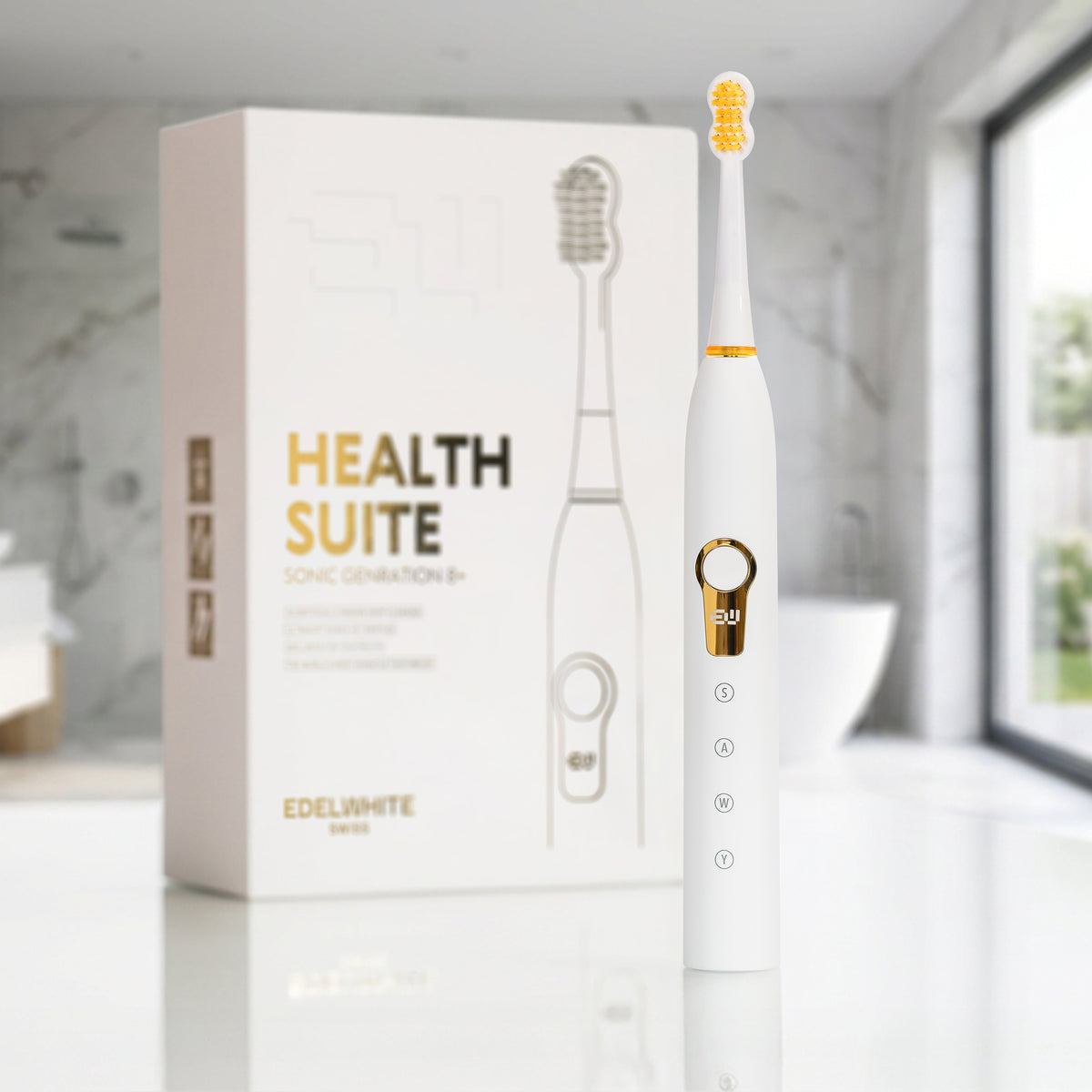
An electric toothbrush is the most complete tool against bad breath, because it cleans the tooth surfaces, the gumline and the entrance to the spaces between the teeth at the same time. The EW-SG8+ Sonic Generation Health Suite was designed to deliver the widest possible cleaning range, thanks to four brush-head shapes that each cover a different area.
Three reasons explain its effectiveness:
- More plaque removed. According to a 2014 Cochrane review of 56 studies and 5,068 participants, powered toothbrushes reduce plaque by 21% and gum inflammation by 11% more than manual brushes after three months. Less plaque and less inflammation mean fewer sulphur gases.
- Filaments that reach into the gumline groove. The patented Konex HD filaments taper to a tip of about 0.02 mm to slip into the gingival sulcus, where tiny particles lodge, and their mechanical pressure-absorption system protects fragile gums. To understand why filament fineness matters so much, read what is the best electric toothbrush for preventing and combating periodontitis and gingivitis?.
- A fluid flow that goes beyond the bristles. At up to 45,000 movements per minute, the SG8+ sets saliva and toothpaste in motion and creates a flow that extends beyond the bristle tips, towards the gumline and between the teeth.
Each Konex HD head has a precise role:
| SG8+ head or mode | Target area | What it changes for your breath |
|---|---|---|
| Dual Clean head | All surfaces, every day | Removes the plaque that feeds odour-causing bacteria |
| Target Clean head (single tuft) | The gumline groove, the entrance to the spaces between teeth, around implants and crowns | Goes straight for the debris reservoirs at the edge of the gum |
| Focus head (round) | The back molars, tooth by tooth | Cleans the area where debris lingers most |
| Sensitive and Yoga modes | Bleeding or inflamed gums | Lets you clean fragile gums thoroughly, which is what allows them to calm down |
| Whitening head and mode | Stains from coffee, tea or tobacco | A bonus for a brighter smile |
The SG8+ also has a 2-minute timer that signals every 30 seconds, so every area, back molars included, gets its share of brushing, plus more than 3 weeks of battery life and a 2-year warranty.
The ideal combination: floss, electric toothbrush and water flosser
The ideal routine against bad breath combines three tools: dental floss, an electric toothbrush with all its Konex HD heads, and a water flosser. Each has a different mechanical action and reaches an area the others only partly cover.
| Tool | Mechanical action | Area it reaches best |
|---|---|---|
| Dental floss | Scrapes the sides of teeth where they touch | The contact point between two teeth, where no brush can go |
| Electric toothbrush (Dual Clean, Focus, Target Clean heads) | Loosens biofilm through vibration and Konex HD filament penetration | Tooth surfaces, the gumline groove, molars, around implants |
| Water flosser | Flushes out debris and bacteria with a pulsating jet of water | The spaces between teeth and the gumline, after brushing |
Think of it like cleaning a house: floss gets into the narrow cracks, the electric toothbrush scrubs every surface and corner, and the water flosser rinses away everything that has been loosened. Used after brushing, the water flosser works like a pressure washer that flushes out the bacteria left behind. To see how the two devices work together, read electric toothbrush and water flosser: do you need both?.
|
The EDELWHITE approach EDELWHITE, the Swiss oral care brand specialising in gum health, has designed a complete range to clean every area where bad breath starts.
Explore our full range of periodontal and gingivitis care. |
The evening anti-bad-breath routine, step by step
The evening routine matters most: during the night, saliva flow drops sharply and bacteria have free rein. Allow about 4 minutes.
- Floss, 1 minute. Slide it between each pair of teeth, curving it into a “C” around each tooth and just under the gum, without forcing.
- Electric toothbrush, 2 minutes. Dual Clean head, bristles angled at 45° towards the gum, guiding the brush tooth by tooth without scrubbing. The timer tells you when to move on.
- Target Clean head, 30 seconds. Go back along the gumline, between the teeth, over crowded teeth and around crowns or implants.
- Water flosser, 1 minute. After brushing, along the gumline and between each tooth, to flush away what has been loosened.
- Spit, don't rinse with water, so the fluoride in your toothpaste keeps working overnight.
In the morning, a 2-minute brush is enough, plus a pass over the tongue if you see a white coating. During the day, drink water regularly: saliva is your best natural deodorant.
Mouthwash, chewing gum, mints: what they really do
Mouthwash, chewing gum and mints mask the odour for a few hours, but they do not remove the trapped particles or the biofilm that produce it. They are useful as extras, never as a replacement for mechanical cleaning.
The most comprehensive Cochrane review on treating bad breath, covering 44 studies and 1,809 people, concluded that the evidence remains low certainty for every option tested, whether mouthwashes, toothpastes or tongue cleaning. There is no miracle product: what works is cleaning each area mechanically, every day.
| Option | Effect on the odour | How long | Our view |
|---|---|---|---|
| Chewing gum, mints | Masks the odour, slightly stimulates saliva | One to two hours | A quick fix, sugar-free if possible |
| Alcohol-based mouthwash | Masks the odour | A few hours | Best avoided daily: it can dry out the mouth |
| Alcohol-free mouthwash | Freshens and complements cleaning | A few hours | A useful extra, for example Fresh&Protect |
| Floss + electric toothbrush + water flosser | Removes the source of the odour | Lasting | The real solution |
When should you see a professional?
See your dentist if your floss still smells after two to three weeks of a complete routine, if your gums bleed, swell or recede, or if a tooth feels loose. These are signs of gingivitis or periodontitis that need professional cleaning. If your gums have started to pull back, read receding gums: how to clean deeply without making gum recession worse.
See your doctor or an ENT specialist if your floss no longer smells, your tongue is clean and the bad breath persists. The cause is then probably outside the teeth: tonsils, sinuses, reflux or another digestive issue. Conversely, some people are convinced they have bad breath when nobody else notices it: a professional can check and reassure you.
Frequently asked questions
What is halitosis?
Halitosis is the medical name for persistent bad breath. In about 90% of cases it comes from the mouth: bacteria break down tiny particles trapped under the gumline and between the teeth, releasing sulphur gases. It is called extra-oral halitosis when the odour comes from the throat, sinuses or digestive system, and pseudo-halitosis when nobody else can detect it.
How do you treat halitosis?
Halitosis that starts in the mouth is treated at the source, by cleaning the areas where the odour is produced every day: floss between the teeth, an electric toothbrush for the surfaces and the gumline groove, and a water flosser after brushing. If your gums bleed, a professional clean at the dentist is often needed. If the odour persists despite a clean mouth, see your doctor.
Why do I have bad breath even though I brush my teeth?
Because the odour is produced where the toothbrush cannot reach: in the groove along the gumline and in the spaces between the teeth. Bacteria break down tiny particles there and release sulphur gases. A 2023 study found that more than 9 in 10 people with bad breath had gum disease. You need to clean those areas, not brush harder.
How can I tell if my bad breath comes from my teeth?
Do the floss test: run floss between your teeth, especially between the molars, then smell it. If it smells, the source is between your teeth and under the gumline. If it smells of nothing, your tongue is clean and the odour persists, the cause is probably elsewhere, in the throat or the digestive system, and you should see a doctor.
Can an electric toothbrush help with bad breath?
Yes, because it tackles the source of the odour. According to a 2014 Cochrane review, powered toothbrushes reduce plaque by 21% and gum inflammation by 11% more than manual brushes after three months. It is the most complete tool, but the ideal is to combine it with floss and a water flosser, which reach the areas it covers less well.
Which electric toothbrush is best for bad breath?
Choose an electric toothbrush with several brush-head shapes, very fine bristles that reach into the gumline groove, a gentle mode for inflamed gums and a 2-minute timer. The EDELWHITE EW-SG8+ Sonic Generation Health Suite comes with 4 Konex HD heads, including a Target Clean head for the gumline and a Focus head for the molars.
Why does my dental floss smell bad?
Floss that smells after use means bacteria have settled between your teeth and under the gumline, where they break down tiny food particles. It is a sign that these areas are not being cleaned enough. Floss every evening, add an electric toothbrush and a water flosser, and repeat the test after two weeks.
Does bad breath come from the stomach?
Rarely. According to a 2014 international expert consensus, the source of the odour lies in the mouth in about 90% of cases. Causes in the throat, sinuses or digestive system affect a minority of people. If your floss smells of nothing and the odour persists despite a complete routine, see your doctor.
Should I use a water flosser before or after brushing?
After brushing. The electric toothbrush loosens the biofilm, and the water flosser then flushes it out with a pulsating jet of water, like a pressure washer that clears away bacteria trapped between the teeth and along the gumline. Dental floss, on the other hand, is used before brushing.
Is mouthwash enough to get rid of bad breath?
No. Mouthwash masks the odour for a few hours, but it does not remove the trapped particles or the biofilm that produce it. A Cochrane review of 44 studies concluded that the evidence remains low certainty for every option tested. Choose an alcohol-free mouthwash as a complement to floss, an electric toothbrush and a water flosser.
Further reading
- Electric toothbrush and water flosser: do you need both? The complete routine
- Gingivitis: symptoms, causes and how long it takes to heal
- Periodontal pockets: how to clean where your toothbrush never reaches
- Periodontitis: symptoms, stages, causes and treatment (the complete guide)
- What is the best electric toothbrush for preventing and combating periodontitis and gingivitis?
This article is for information only and does not replace the advice of a dentist or periodontist.