


Sensitive teeth: causes, what actually works and how to brush without pain
A sip of iced water, a spoonful of ice cream, a slice of lemon, and suddenly that sharp, short pain makes you wince. If that sounds familiar, you are far from alone: in a large European study across seven countries, 41.9% of the young adults examined showed tooth sensitivity during a clinical test.
The good news is that this pain almost always has a simple mechanical explanation, and part of the solution is in your bathroom. Sensitivity has several causes, but the way you brush can keep it going, or help it settle. Here is what is really happening, what works, and what to change from tonight.
|
The essentials in 30 seconds
|
Sensitive teeth: what is actually happening?
Tooth sensitivity, which dentists call dentine hypersensitivity, is pain arising from exposed dentine, typically in response to cold, heat, sweet or acidic foods, or touch. It is sharp and brief, and stops as soon as the trigger is gone.
To understand it, look beneath the enamel. Dentine, which makes up the body of the tooth, is crossed by thousands of microscopic fluid-filled tubules that connect its surface to the nerve. As long as enamel or gum covers it, these tubules are protected. Once dentine is exposed, cold or sugar makes that fluid move, and the movement stimulates the nerve: this is the hydrodynamic theory, the most widely accepted explanation. The more open and wide the tubules, the stronger the pain. Seal them, and the pain eases.
Hence the key idea for everything that follows: treating sensitivity means protecting exposed dentine first, then sealing its tubules.
Why dentine becomes exposed: the 3 main causes
In the European study, sensitivity was clearly linked to two factors: acid-related tooth wear and gum recession. Brushing acts as an accelerator.
Receding gums
When gums recede, they uncover the root of the tooth. Roots have no enamel: their dentine is directly exposed, especially at the neck of the tooth, where tooth meets gum. Recession usually has several causes that add up: gum inflammation, naturally thin gums, misaligned teeth and sometimes traumatic brushing. To protect your gums, read our guide on how to clean deeply without making gum recession worse.
Acidic food and drink
Fizzy drinks, energy drinks, citrus fruit, fruit juice, wine, vinegar: acids soften the surface of enamel and dentine. Acid reflux and repeated vomiting have the same effect. In the European study, acid wear was strongly and progressively associated with sensitivity, and energy drinks, reflux and an acidic diet were among the risk factors.
Abrasive brushing, especially straight after acids
Brushing on its own causes very little wear to enamel. What wears away exposed dentine is the combination of an abrasive toothpaste, too much pressure and stiff bristles. Timing matters too: dentine softened by acid becomes even more vulnerable to abrasion, and brushing straight after an acidic drink is one of the factors that open the tubules. That is why the quality of your toothbrush matters: our guide on how to choose the right electric toothbrush explains what to look for in bristles and brush heads.
Some sensitivity is temporary: after a scale and polish, a deep clean (root planing) or whitening, a few days of sensitivity is common. Our complete guide to periodontitis explains what each gum treatment involves.
Your toothbrush can make sensitivity worse, or calm it
This is the most underestimated lever. A Swiss team measured the force 27 adults actually applied while brushing their teeth. With a manual toothbrush, average pressure reached 1.6 newtons, against 0.9 newtons with a sonic toothbrush: almost half. In the lab, at those real-life forces, the manual toothbrush caused the most wear on dentine, both healthy and eroded. The authors conclude that people with exposed or eroded dentine should use a sonic toothbrush to limit abrasion.
The explanation is simple: with a sonic toothbrush, the device creates the movement. You no longer need to scrub, so you press less. The leading review on tooth sensitivity reaches the same conclusion: electric toothbrushes are considered less abrasive, partly because people apply less force with them.
| What keeps sensitivity going | What calms it |
|---|---|
| Pressing hard and scrubbing back and forth | Gliding the head slowly along the teeth with a light touch |
| Hard or medium bristles | Ultra-soft, fine-tipped filaments |
| A whitening or abrasive toothpaste (above 80 RDA) | A low-abrasion desensitising toothpaste (80 RDA maximum) |
| Rinsing with water straight after brushing | Spitting without rinsing, so the fluoride keeps working |
| Brushing straight after orange juice or a fizzy drink | Rinsing with water, then waiting before brushing |
| Lingering on the sensitive neck of the tooth | A gentle mode and a precision head placed without pressure |
What works, at home and at the dentist
Desensitising toothpaste, with a little patience
Toothpastes for sensitive teeth work in two ways: some calm nerve transmission, others seal the dentine tubules to stop the fluid from moving. A network meta-analysis of 30 clinical trials compared the main active ingredients. Those that seal the tubules came out best: nano-hydroxyapatite ranked first at 2 and 4 weeks, arginine at 8 weeks, and stannous fluoride outperformed standard fluoride toothpaste. A significant placebo effect was also noted, and the uneven quality of the trials calls for caution.
In practice: use your desensitising toothpaste every time you brush, without rinsing afterwards (more on why below), and judge the result after several weeks, not three days.
Treatment at the dentist
If sensitivity persists despite these changes, your dentist has more targeted options: fluoride varnish, a desensitising agent, a resin that seals an exposed tooth neck and, for significant recession, a gum graft. They will start by looking for the cause, because that is what determines the long-term result.
Should you rinse your mouth after brushing?
No, and it is one of the most useful tips for sensitive teeth. After brushing, spit out the excess toothpaste, but don't rinse your mouth with water. UK public health guidance makes this a strong recommendation, to avoid diluting the fluoride.
The reason is simple: the active ingredients in your toothpaste keep working after you brush. Fluoride strengthens enamel, and desensitising agents such as BioMin®, the calcium fluorophosphosilicate in our STOP Sensitive gel, gradually release fluoride, calcium and phosphate to help seal the dentine tubules. The longer they stay in contact with your teeth, the more time they have to work. A big rinse washes them away in seconds.
The exception: whitening toothpastes
Many dentists advise against whitening toothpastes for sensitive teeth. To remove stains, many of them rely on more abrasive particles: stain removal becomes markedly stronger above 100 RDA. On exposed dentine, that friction strips away the thin protective layer over the tubule openings, reopens them and can widen them. The result: more sensitivity.
For these toothpastes, the rule is reversed. If you use one, rinse your mouth straight after brushing, so that its abrasive particles and whitening agents don't stay in contact with dentine that is already vulnerable. The safest option is to avoid them while your teeth are sensitive, especially the abrasive ones.
How to tell if a toothpaste is abrasive: the RDA score
A toothpaste's abrasiveness is measured by its RDA score (Relative Dentin Abrasivity): a laboratory test compares the dentine wear it causes with that of a reference abrasive set at 100. The higher the number, the more the toothpaste wears dentine. The international standard allows up to 250 RDA, so a toothpaste can be approved and still be too abrasive for exposed dentine. That is why specialists recommend low- or moderate-abrasion toothpastes for people at risk.
| RDA score | Our advice for sensitive teeth |
|---|---|
| Up to 80 | Low abrasion: suitable for daily use |
| Above 80 | Abrasive: avoid while your teeth are sensitive |
The RDA score is not always printed on the tube: look it up on the brand's website, or ask your pharmacist or dentist.
The 6-step plan for sensitive teeth
- Switch to a sonic toothbrush with ultra-soft filaments. You will press less, and wear away less exposed dentine.
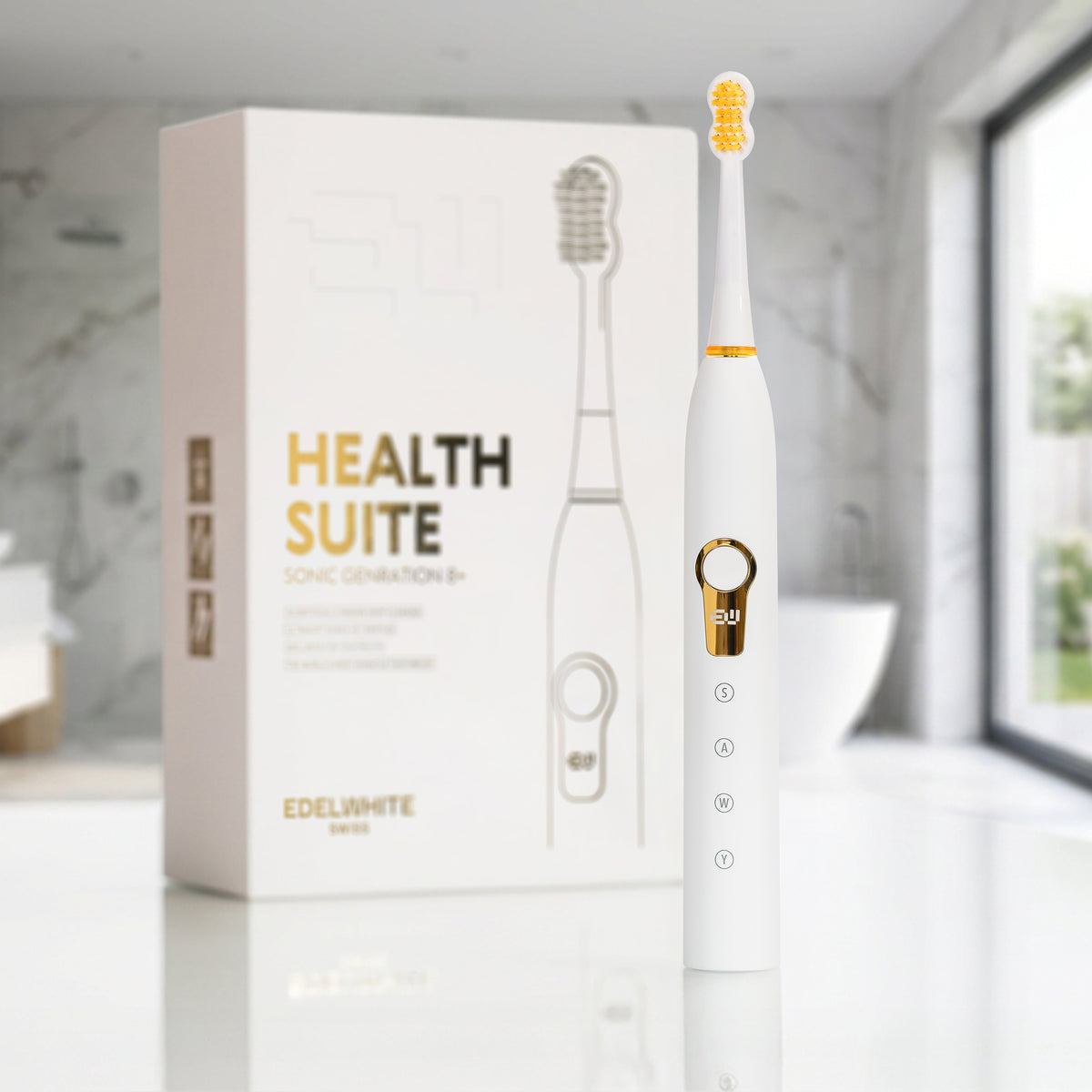
- Start in a gentle mode. On the Health Suite 8+, Sensitive mode is designed for the first weeks.
- Stop scrubbing. Angle the head towards the gum, rest it there without pressing and guide it slowly from tooth to tooth, for 2 minutes in total.
- Use a low-abrasion desensitising toothpaste (80 RDA maximum) twice a day, and spit without rinsing. Avoid whitening toothpastes.
- After acidic food or drink, rinse your mouth with water and wait before brushing. Half an hour is often recommended.
- Look after your gums. Daily interdental cleaning limits the inflammation that makes gums recede. If your gums bleed, read our guide to gingivitis: symptoms, causes and how long it takes to heal.
Health Suite 8+ and STOP Sensitive: our pairing for sensitive teeth
At EDELWHITE, we design our products to clean deeply without harming the gums or the dentine. For sensitive teeth, two of them work naturally together.
Health Suite 8+: effective brushing without pressing
| What sensitive teeth need | What the Health Suite 8+ does |
|---|---|
| Less pressure | Sonic technology at up to 42,000 movements per minute: the device does the work, so you no longer need to scrub |
| Filaments that spare the dentine | Konex HD® filaments, 8 times thinner than standard bristles and gentle on sensitive gums and exposed roots |
| Brushing adapted to pain | Four modes, including Sensitive |
| Cleaning the gumline without irritating it | Three brush heads included: Target for the groove between tooth and gum, Focus for tooth-by-tooth brushing and Dual Clean for everyday use |
| Built to last | Up to two weeks of use per charge, a premium travel case and a 2-year warranty |
STOP Sensitive gel: soothe and protect
Our STOP Sensitive gel is used like a toothpaste, twice a day. It combines BioMin® (calcium fluorophosphosilicate), bioactive glass particles that cling to the teeth and gradually release calcium, phosphate and fluoride, with 1,430 ppm fluoride. It is designed to plug exposed dentine tubules and strengthen enamel, and it is free from SLS, parabens and titanium dioxide. Use a pea-sized amount, brush for 2 to 3 minutes, then spit without rinsing so that it keeps working for as long as possible. Used with a gentle sonic toothbrush, it works on both levers: less abrasion on one side, better-protected tubules on the other.
|
Brush without pressing, starting tonight The Health Suite 8+ combines sonic technology, Konex HD® filaments and a Sensitive mode for a thorough clean that spares sensitive teeth. 2-year warranty, free shipping on orders over €50 / CHF 50, delivery in 2 to 5 business days. |
When to see a dentist straight away
True tooth sensitivity is brief and stops with the trigger. Some signs call for a prompt dental visit, because they point to another cause, such as tooth decay, a crack, nerve inflammation or an infection:
- pain that lasts several seconds or minutes after cold or heat;
- pain that comes on by itself, with no trigger, or wakes you at night;
- pain when chewing, or pain limited to a single tooth;
- swelling of the gum or cheek;
- sensitivity that does not improve after several weeks of good habits and desensitising toothpaste.
In short
Sensitive teeth almost always mean exposed dentine, caused by receding gums, acids or abrasive brushing. To calm them for good, protect that dentine: brush with a sonic toothbrush with ultra-soft filaments, without pressing; use a low-abrasion desensitising toothpaste and spit without rinsing; rinse with water after anything acidic; and look after your gums. That is exactly what we designed the Health Suite 8+ for, and our STOP Sensitive gel completes it every day.
Frequently asked questions
Why are my teeth sensitive to cold?
Because the dentine, normally protected by enamel and gum, is exposed. Cold makes the fluid inside its microscopic tubules move, which stimulates the tooth's nerve. The most common causes are receding gums, an acidic diet and abrasive brushing.
Are sensitive teeth serious?
Usually not: sensitivity is a warning sign of exposed dentine. But pain that lingers, comes on by itself, wakes you at night or affects a single tooth can point to decay, a crack or an infection. In those cases, see a dentist promptly.
Is an electric toothbrush suitable for sensitive teeth?
Yes, as long as it is gentle. In one study, people using a sonic toothbrush pressed almost half as hard as with a manual one, and wore away less exposed dentine. Choose ultra-soft filaments and start with a gentle mode.
How long does toothpaste for sensitive teeth take to work?
Allow several weeks. In clinical trials, results are measured after 2 to 8 weeks of regular use, twice a day. If nothing has changed by then, talk to your dentist.
Should you wait before brushing after eating something acidic?
Yes. Acid softens the surface of the dentine and makes it more vulnerable to abrasion. Rinse your mouth with water, then wait before brushing: half an hour is often recommended.
Should you rinse your mouth after brushing your teeth?
No, if your toothpaste contains fluoride or a desensitising agent: spit out the excess without rinsing with water. This avoids diluting the fluoride and gives ingredients such as BioMin® time to protect the dentine tubules. The one exception is whitening toothpaste, which is best rinsed off straight after brushing, and avoided if your teeth are sensitive.
Is sensitivity after a scale and polish or whitening normal?
Yes, it is common and usually fades within a few days. A desensitising toothpaste and gentle brushing help you through it. If it lasts more than two weeks, tell your dentist.
Do whitening toothpastes make sensitivity worse?
Often, yes. To remove stains, many rely on more abrasive particles, which reopen the tubules of exposed dentine. If your teeth are sensitive, avoid them, especially above 80 RDA, and if you do use one, rinse your mouth straight after brushing.
Is the Health Suite 8+ suitable for sensitive teeth?
Yes. Its sonic technology means you no longer need to scrub, its ultra-fine Konex HD® filaments are gentle on dentine and gums, and its Sensitive mode is designed for sensitive mouths. Pair it with our STOP Sensitive gel to protect your enamel as well.
Further reading
- Receding gums: how to clean deeply without making gum recession worse
- Gingivitis: symptoms, causes and how long it takes to heal
- Periodontal pockets: how to clean where your toothbrush never reaches
- How to choose the right electric toothbrush
- Prevalence of dentine hypersensitivity and study of associated factors: a European population-based cross-sectional study. J Dent. 2013. doi:10.1016/j.jdent.2013.07.017. PubMed
- Dentin hypersensitivity: pain mechanisms and aetiology of exposed cervical dentin. Clin Oral Investig. 2013;17(Suppl 1):S9-S19. doi:10.1007/s00784-012-0887-x. Cardiff University- Brushing force of manual and sonic toothbrushes affects dental hard tissue abrasion. Clin Oral Investig. 2013;17(3):815-822. PubMed
- Network meta-analysis on the effect of desensitizing toothpastes on dentine hypersensitivity. J Dent. 2019;88:103170. Dental Elf summary
- Delivering better oral health: an evidence-based toolkit for prevention, chapter 2 (UK Government). GOV.UK
- Protected by a safe RDA: setting the record straight about toothpaste abrasivity. RDH Magazine. 2016. RDH